Logo Design Process

Logo Design Process
Recently, as I worked on a logo design for a local art studio, I thought about how my process is the same for every logo project, and has been the same for years.

  1. Client interview. One of the most important steps! Learn what the client is looking for, the image they want to portray, and if they have ideas of their own, color preferences, etc.
  2. Pencil sketches. I always start with a pencil and paper, and sketch out as many concepts as I can. I also try to explore the logo as different shapes.
  3. Font analysis. This is where I go through my font catalog, and find different font options that support my concepts and the “feel” we are going for. I view the company/client name in the different fonts, and narrow the choices down.
  4. Create/find artwork. I draw (on the computer) any artwork/illustrations that will be part of the logo. If you aren’t comfortable with illustration, look through stock image sites, for artwork you can incorporate into your designs. Vector files can easily be customized.
  5. Logo design in Illustrator. I work in Illustrator, to bring to life my pencil sketches. Often I’ll scan them, to use as a template for the designs. It’s important to create the logo as a vector file (for enlarging, etc.). A vector file can be rasterized (and saved as a jpg, etc.) but not the reverse.
  6. Explore several options. I like to develop several versions to present to the client. Often I step away from the process for a night, because I come back to it with fresh ideas.
  7. Present the best ideas to the client. Some people don’t like to present too many options, but I think clients like choices. It’s very subjective. The logo I think is the best, might not be the one they prefer.
  8. Client input. What the client thinks is the most important thing – if they want to change elements of the design(s), or even don’t like the first round of versions, it’s important to remember the logo is meant to be a representation of them. Often people have to see something to realize it works (or doesn’t).
  9. Present revised design(s) or new versions. After the client’s input, I make the appropriate revisions or, occasionally I have go back to the drawing board (step #2 or #5). Usually working with the client through 1 or 2 rounds of revisions, will bring us to:
  10. Approved design. My goal is a happy, satisfied client.

Want to see some of the logos I’ve designed? Visit my website: www.eileenmckenna.com.

Designing Patterns – important things to remember.

monkeysketch
If I knew what I was getting into, maybe I wouldn’t have been so enthusiastic about pursuing pattern design. Ha ha. I say this because I am realizing all the aspects that go into designing for fabric, gift wrap, and beyond. My head was spinning a bit this weekend, as all I took it all in.

Things I need to remember:

  1. Select colors from a color guide, don’t rely on the computer screen. As a graphic designer, I should know this, but I get caught up in the screen colors and forget. Then my swatch arrives and I’m surprised by the colors! And I have a fabric swatch of Spoonflower’s color guide! Now, I’m keeping it next to my computer.
  2. What is the repeat? I get caught up in the illustrations, and forget that the way they work together is almost more important than what they are. I’m reading an interesting book called Patternalia, An Unconventional History of Polka Dots, Stripes, Plaid, Camouflage, & Other Graphic Patterns. It’s a quirky book. I’ve already started to look at patterns differently. In the book, they mention pattern effects like “figure-ground reversal – This is where the figure and background are equally sized and therefore easily confused with each other.”
  3. Observe other patterns. I find observing helpful when I’m trying to learn something new. Looking through patterns, determining if I think they are “successful,” and why, is really helping me. Again, it is all about how the elements work together and repeat.
  4. Is simpler better? I definitely overcomplicate things. I need to remember that simple is often better. Some of the successful Spoonflower patterns I looked through, had the simplest elements.

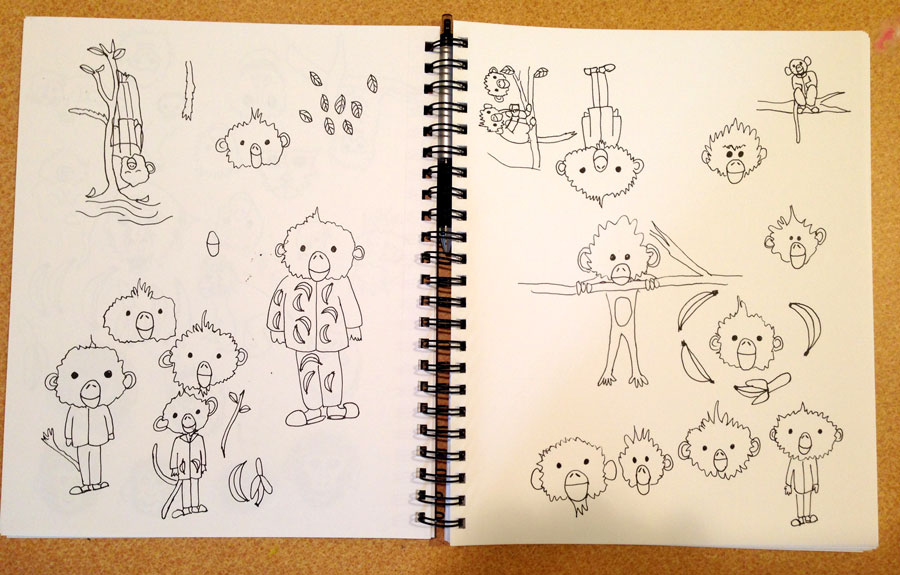
I decided to give the latest Spoonflower contest a try: The Year of the Monkey. I started by doodling in my sketchbook. At first, my monkeys were downright scary – too realistic, too scary. After I simplified them, they got cuter. When I had a few I liked, I started to sketch out how they could work together. I was getting very detailed and complicated, with many elements. When I sat at the computer, and scanned in my favorite illustrations, I made the decision to simplify. The deadline is today after all! 😉

Planning the pattern:
monkeysketch2

Painting with color

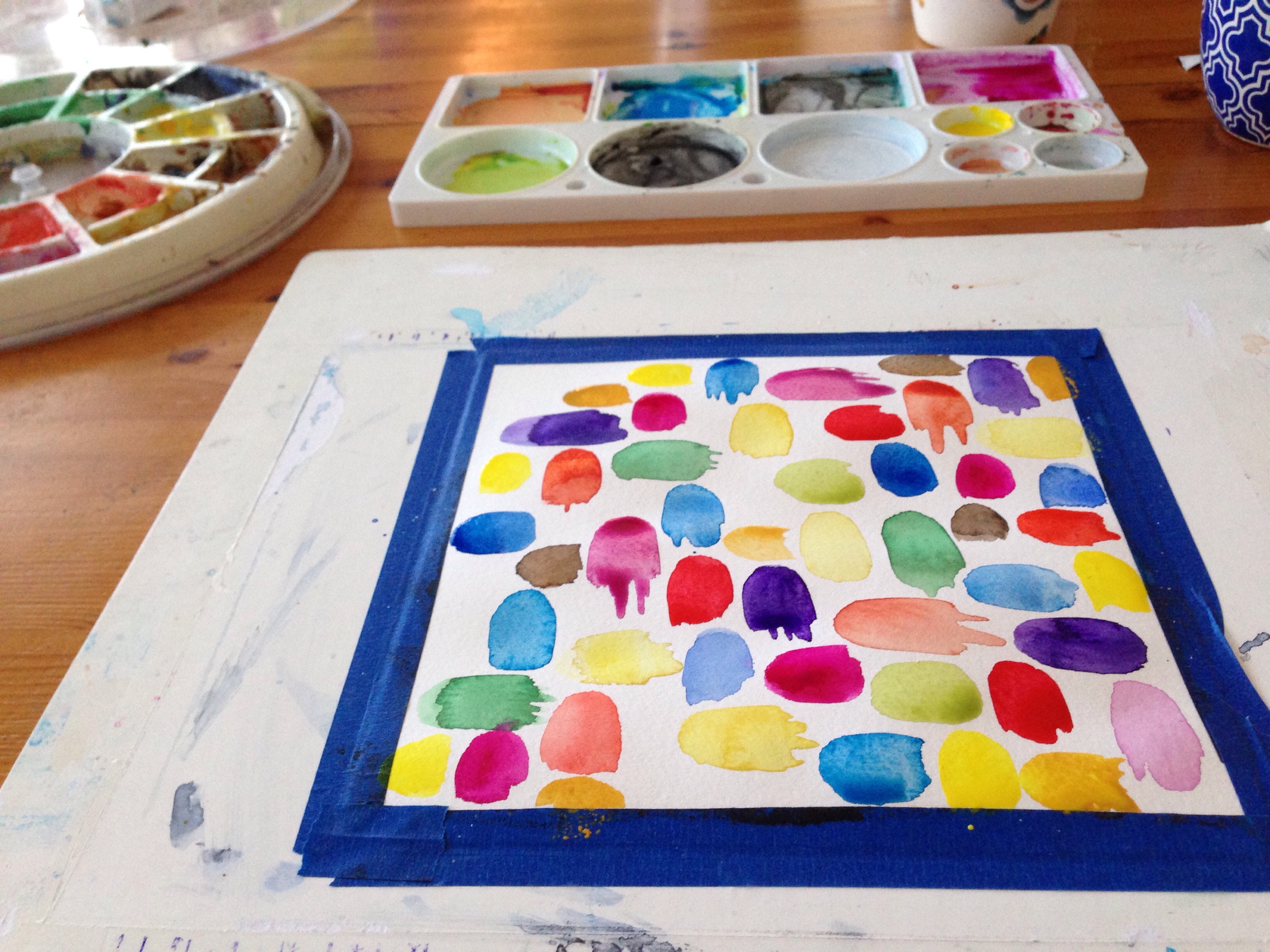
Today I decided to paint with lots of bright cheery colors. I’ve been creating all weekend and thinking about what to post. Sometimes, when too much time has past, I overthink what to write about. It’s usually a case of too many ideas! I complicate things. So to simplify – this is what I’m painting right now. 🙂

Learning the keys to successful surface design

valentine2015repeatsm
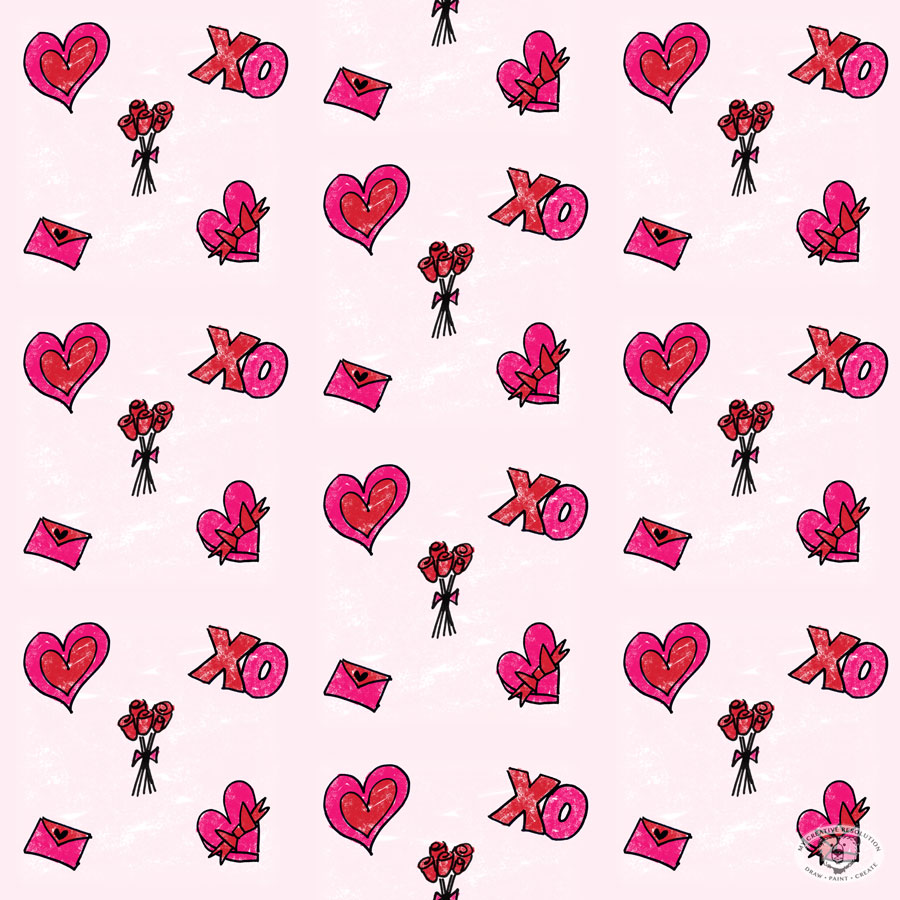
At the end of last year, I had just started ordering my pattern designs in wrapping paper and fabric. It’s totally different, to not only see the pattern printed, but then work with the gift wrap and fabric. As I wrapped presents in my designs and other designs, I became aware of things that I never noticed before. Most importantly that a lot of the designs have some elements that are upside down and some right side up. This way, there is no correct side.

Over the summer, when I ordered fabric in my sandcastles design, I experimented with making it into a pillow. I realized how important the size of the repeat is. If it is too big, and you try to make a small pillow (or wrap a small present), then most of the design gets cut off.

These are things you don’t notice when you are creating on the computer. As I continue to pursue surface design this year, my goal is to not only design patterns, but have them printed as gift wrap or fabric, and (most importantly) create something with them – to be the end user. I think it’s the best way for me to learn how to make successful designs.

Earlier this week I tweaked last year’s Valentine’s Day design and ordered a swatch (see above). Specifically, I changed how the pattern repeated. I’m am excitedly waiting it’s arrival! I am also working on a second Valentine’s Day themed pattern, that has more of a watercolor feel.

Original Repeat:
valentine'sdaypattern

To see the 12 patterns I designed in 2016, click here.

Just 5 minutes of sketching

This slideshow requires JavaScript.


I’ve been sketching everyday. To accomplish this I’ve committed to “just 5 minutes.” Even on the busiest days, I figure I can spare 5 minutes. My old schedule was of a couple of hours of creating, one day a week, with shorter periods added here and there. But by the time another creative day came along, I sometimes couldn’t remember what I had been working on. These short sketching sessions keep me in the creative mode. They have been great. A great way to practice, come up with ideas, or just relax. And sometimes it goes beyond 5 minutes. 🙂

Hope your having a creative New Year!

New Year, New Banner

2016banner
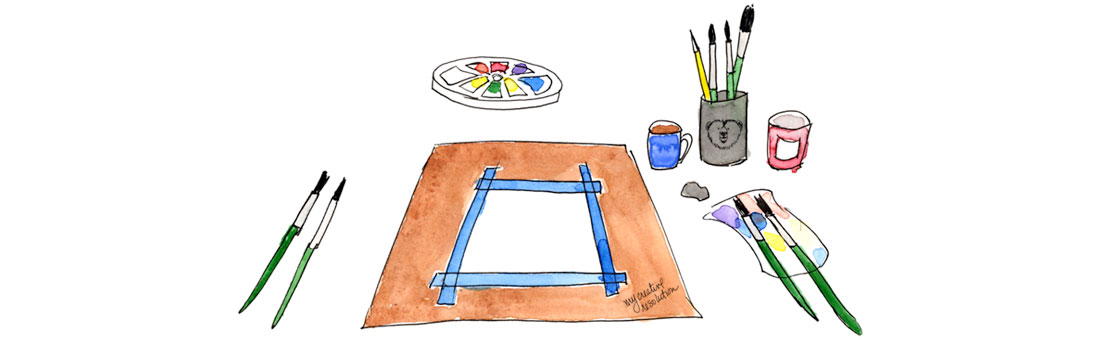
I thought it would be appropriate to design a banner that better represented what I do. So, why not a sketch of my painting setup? I’ve kept my bear in there, on the can holding the brushes. If you are wondering what’s with the bear – read my about page.

The New Year, has given me a recharge. I’m more committed to being creative than I was at the start (of 2014). I’m excited to pursue all the different things I’m interested in (painting, illustration, surface design, animation). I’m trying to doodle in my sketchbook every day. I ask myself for only 5 minutes. Even on the busiest days, I can spare that right? It’s relaxing, and it allows me time to come up with ideas. I usually do it early in the morning, while I wait for the kids to get ready. It puts me in a creative mindset for the day. And because of that, I usually end up creating later in the day.

Hope your New Year is off to a creative start too!


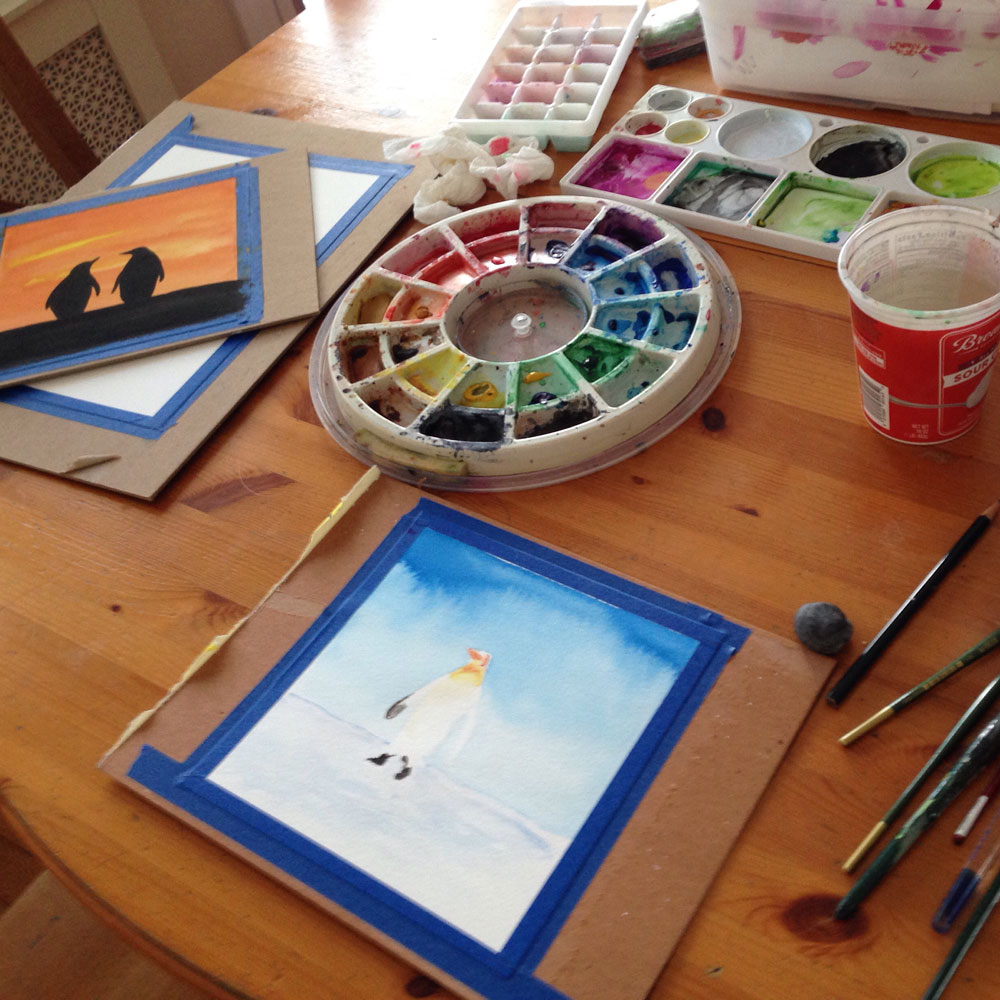
Starting the year off right with a painting.

penguins
It felt so good, to set up yesterday – take my paints out, tape down the paper, fill the water – just go through the process. I’ve missed it. I’ve painted only sporadically during the holiday season. Setting up is kind of a calming.

I had no idea what I wanted to paint, I just knew I wanted to get back into it. Penguins popped into my head, and orange sunset skies. I looked online for some reference photos and found a great one tagged #penguinlove. I wish I could find the photographer of the inspiration photo. It’s so awesome, I can’t really take credit for the painting. I usually try to take my own reference photos, but there aren’t any penguins here in NY!
penguin

How’s your year starting out? Have you starting on your resolution? 🙂

9 Tips to Help You Keep Your New Year’s Resolution

9 Tips to Help You Keep Your New Year's resolution #resolution #new #years
My 2014 resolution was to be more creative. I came across a note I wrote six months in, “just pull out the paints.” Now, four years later, I realize keeping a resolution isn’t that simple. I know my success has been much more specific than that. There are ups and downs to any resolution. There are times when you are into it, and times when you aren’t. Sometimes it’s hard to just “pull out the paints” (or eat a salad, or put on your running shoes, or stay away from sugar, etc.). Here are some of the strategies I’ve used to help me keep my creative resolution.

9 Tips to Help You Keep Your New Year’s Resolution:

  1. Make a “positive” resolution. Your resolution should be about what you are going to do, not what you are not going to do. For example – Eat healthy vs. Stop eating junk.
  2. Research your resolution. Read books, magazines, blogs, or watch videos about your topic. Learning about your topic will motivate you, and help you on your journey.
  3. Tell people about your resolution. The more you tell others what you have resolved to do, the more you’ll feel committed to doing it, and it may help you connect with people with similar goals.
  4. Keep track of your progress. Keep a journal, or a blog about your journey, and include all your struggles and victories. Reread it from time to time to remind yourself how far you’ve come. The blogging community can be very supportive!
  5. Be realistic. Start small. If your resolution is running, you can’t expect to run 3 miles the first day out. And if you do, you’ll probably not want to run the next day! Start small, and build on it.
  6. Spend money. You’ll be more motivated and committed if you spend money. It’s the spending guilt! Buy new healthy snacks, new running sneakers, art supplies, or whatever items support your resolution.
  7. Schedule time. You can’t change your eating, or exercise, or paint, or meditate, if you don’t have time. Make your resolution a priority by scheduling time for it.
  8. Be specific. Although my resolution was to be more creative, on a weekly basis I write a list of specific goals and to do items within that resolution.
  9. Challenge yourself. Over time the same thing gets boring. After you achieve the first level of success, challenge yourself with new goals within your resolution – a new type of exercise, sign up for a race, register for a class, commit to making a new healthy recipe each week, or try another art form. Keep things interesting!

According to statisticbrain.com 41% of Americans usually make New Year’s Resolutions. Only 9.2% felt they were successful in achieving their resolution. I hope my tips help you keep your resolution this year. 🙂

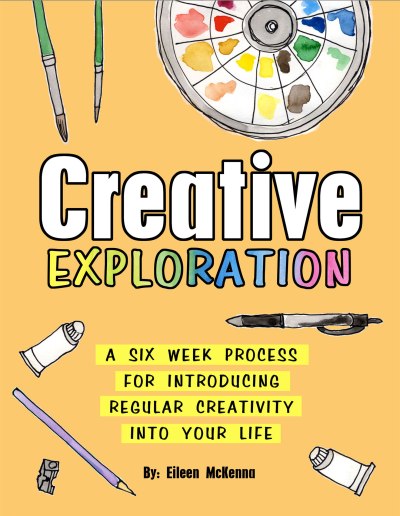
What are your creative plans for 2020? Hoping for a creative year but don’t know where to start? Try my book Creative Exploration: A Six Week Process for Introducing Regular Creativity into your Life – Develop a regular practice of creating, explore mediums and subjects in search of your thing, and experience the joy that creativity brings. Creativity is for EVERYONE! Talent is just a starting point.

Creative Exploration book -

Looking back and looking forward on my creative resolution

artistsetup

When I first made “my creative resolution” just before the start of 2014, my mission statement was: “Hoping to draw, paint, and create my way through 2014.”

I just wanted to be creative. I didn’t even know what I’d be working on. My interests were a varied list of painting, working with recycled materials, refinishing furniture, decorating my mantle, etc. The real goal was to be creative on a regular basis, and finish projects. I had a terrible habit of never finishing things. I made great progress in 2014, my interests became more focused on drawing and painting, and I finished almost everything I started, including some old projects.

At the start of 2015, my mission statement was: Continuing my creative journey into 2015.”

I knew I had come so far, and I wanted to keep growing, and learning. I wasn’t giving up. I had a long lists of goals, although this list, wasn’t as varied as the year before.

Things I want to try in 2015:

  1. Linocut
  2. Lettering
  3. Online workshops
  4. Painting on dark paper
  5. Doodling
  6. Video
  7. Patterns
  8. Maps
  9. Digital Brushes
  10. Watercolor Parties

Most of these items, I tried at least once. Some, like designing patterns (surface design), I adopted as a monthly goal. See all my 2015 patterns here.

My mission statement for 2016 is more of a declaration of me: “Painting, Illustration, Surface Design, and Animation.”

I want to continue painting, working on my illustration style, and designing surface patterns. And I want to learn and grow in the area of animation. See my recent post on exploring animation here.

It’s important to look at where you’ve been, and plan on where you want to go. These two years have been amazing for me. I’ve grown so much on this creative journey. I’ve met amazing friends. It has made me feel happy and fulfilled, and I’m excited about what 2016 will bring. 🙂