Creative Habits

scissors

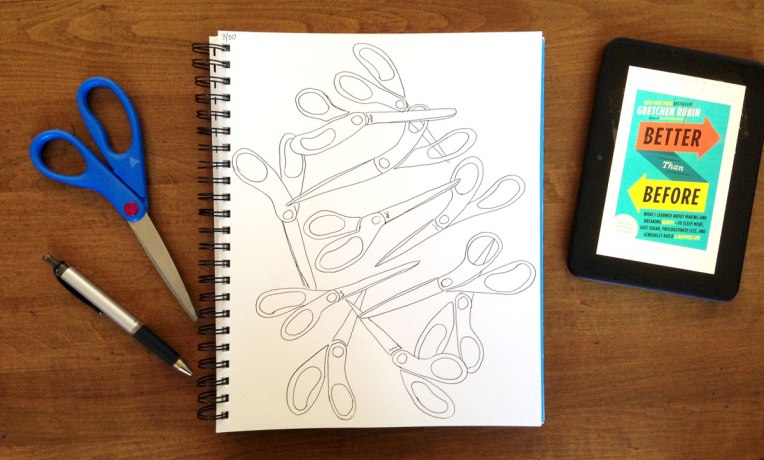
Early last year, I was struggling to get back into a creative routine. I spent a lot of time thinking I should draw or paint, but for some reason I couldn’t motivate myself to pull out my art supplies and get going. I knew starting was the hardest part, but still I couldn’t do it. By chance I started reading Gretchen Rubin’s book, “Better Than Before: What I Learned About Making and Breaking Habits – to Sleep More, Quit Sugar, Procrastinate Less, and Generally Build a Happier Life.” Within a few pages, I had the answer to my problem. I had fallen out of the habit of being creative. It was harder for me to do it, because I had to make the conscious decision to do it. It was an internal willpower battle every time and was no longer a habit – something I did without thinking.

Rubin perfectly states it here,

“When we change our habits, we change our lives. We can use decision making to choose the habits we want to form, we can use willpower to get the habit started; then – and this is the best part – we can allow the extraordinary power of habit to take over. We take our hands off the wheel of decision, our foot off the gas of willpower, and rely on the cruise control of habits.”

This was an “aha” moment for me. I immediately took action, following Rubin’s advice to try to make creativity a habit again. I highly recommend you read this book!

This post contains affiliate links.

I’ll admit it…There aren’t any daily creative habits going on here :(

sketchwithsneaks
I admire those that have committed to a daily creative practice and keep to it. People like Crystal Moody and Charlie O’Shields and so many others. But I can’t do it. I’ve done it for short spurts – 14 days for Valentine’s Day or 17 days for St. Patrick’s Day. I’ve done numerous consecutive days in my sketchbook but inevitably I break the chain.

I’d like to say, “I don’t have the time,” but that isn’t entirely true. I do have other things going on that take a lot of my time – my family, which includes my 3 kids, and my design and marketing business. But I also find time to binge watch Netflix shows, so time isn’t the whole problem.

I get very focus on whatever project I’m working on. It may be painting, or my sketchbook, or it may be a new website I’m developing, or getting the kids ready for the start of the school year. I’ll have blinders on and that project will be what I do when I have a minute to spare. Sure I’m still multi-tasking all the other stuff, but it can be hard to mentally squeeze something else in. Lately my creative practice feels scattered, like it hasn’t been the focus in a while.

It’s not that I’m not a disciplined person. I run 3 days a week. Eat fairly healthy. I am very disciplined about my work. I work from home for myself. So I guess I need to be.

I know from Gretchen Rubin’s book “Better than Before” that it’s easier when something is a habit. We do it without thinking. There is no internal willpower struggle to do it. I put on my running clothes and sneakers when it’s time to run. I may not be happy about it all the time, but I get out there and do it.

I was briefly in the habit of sketching with my coffee while I waited for the kids to get dressed for school. I’d sit down with my coffee, grab the sketchbook without thinking, and start doodling any everyday object I could find. It was great, and it would get me thinking of things I’d like to paint. This 5 minute habit encouraged more creativity. But inevitably one day I wouldn’t feel like it and the doodling would become only occasionally.

Being creative makes me happy, but right now I feel like I’m only doing the bare minimum. I know a daily habit is very effective for many people. I also know it’s not my personality. Some days I want to dive into creativity and other days I want to, or have to, dive into something else. For me it doesn’t have to be daily, but I need some kind of structure and routine to make sure the creativity happens.

I read in Rubin’s book about bundling habits. Adding something to an already established habit. That’s what I’m going to try now. On the days I go running, I’m going to create. As I get ready for my run, I’m going to set up my supplies. I’ll get the process started and when I come back from my run, I’ll “dig in” and get creative.

How do you make sure your creativity happens?


“Can I sell this?” can squash creativity

tiels)
I used to start creating something, not even finish, and jump to “Can I sell this?” I think I was in this mindset because at the time my creative outlet was my custom invitation/announcement business. This type of thinking was stifling my creativity, and was getting annoying. It prevented me from following through on ideas.

I started drawing and painting and left the invitation business behind. Classes really helped get me going, but after a while I wanted to see what I would work on on my own. What would inspire me without class assignments? But I had trouble motivating myself, so I started this blog. There in my original notes for this blog was “spend 3 months creating then open an online shop.”

I had given myself permission to create whatever I felt like, and to worry about selling later, even if it was just for 3 months. Once I started working at it, projects led to other project ideas. Trying one technique led to the desire to learn and try other techniques. I fell in love with creating. The voice asking, “can I sell this?” got quieter and quieter.

But, I saw other artist selling on different sites, in different ways, and wondered, “what is the best way?” So after ten months, I wrote a post asking for input on “where to sell.” One comment closed the door on selling for me:

Robert McArthur wrote,
“Hi,
I know this doesn’t answer your question, but I do have a string set of thoughts on this that I would like to share with you. Unless you have a pressing financial need to sell your work, I feel it is best to not consider selling your work. Instead focus on your art. Do you need to sell? If so ignore this. Otherwise, the need to make your work marketable will, if even subconsciously, cause you to change what you do, thus preventing you from freely developing naturally.”

My reply was,
“I appreciate your comment! I have been thinking the same thing. As I think about selling, I’ve been playing around with creating things that are more marketable. Just as you say, it’s affecting what I create. I really enjoy playing and creating whatever comes to me. I love how the final piece can be so unexpected (to me). If I continue in this way, I risk taking some of the joy out of creating. And the pieces I really love I wouldn’t consider selling! Thank you for writing what I was thinking.”

Robert McArthur had put into words that “thing” that had previously ruined my creativity. I was having so much fun creating I didn’t want to ruin it. And spending my time filling orders didn’t sound fun either.

Currently my state of mind is that my business is print and web design. But, I draw and paint because I love it. It brings me joy. I create patterns because I think it is fun to turn illustrations into patterns, and I love seeing those patterns printed. (My patterns are available for sale, but that wasn’t the motivation in creating them.)

It is very freeing not thinking about selling or what other people are doing. Although those paintings are piling up. Never say never. 😉

 

Creativity breeds more creativity

tulips
I’m already noticing a difference in my level of creativity, just a week after restarting my creative habits. It’s amazing how sketching every morning – often for just 5 minutes – leads to more sketching and painting later in the day. As Maya Angelou said, “You can’t use up creativity. The more you use, the more you have.”

My creative habits were derailed a month or so ago, when I was busy with a work project. I forget how much I need my own creative projects. Working as a web and print designer, I have the pleasure of being creative with work. The downfall for me is relying on work as my creative outlet. Last month’s work project was very consuming and creatively fulfilling. I barely drew or painted during this time. Everything was great until the project wrapped up, and a new work project didn’t immediately replace it. I was out of the habit of working on my own stuff, so I was left feeling somewhat empty. As I wrote about in this post, I was having a really hard time motivating myself to work on my own projects.

Thankfully I was able to get back to it, although it’s not always easy to stick to it. I need to remember this lesson next time work gets very busy – to make time for my own creative projects, and to stick with my creative habits.


10 ways to find inspiration for your creative projects

10 Ways to come up with ideas for your creative projects
I originally wrote a version of this post just one month into my creative resolution. Almost two years later, many of these ideas still work for me! The biggest change since then? The inspiration I get from others through social media.

Ten ways to find inspiration for your creative projects:

  1. Scroll through your feed or do a search on WordPress, Instagram, Pinterest, etc. – there is so much to look at and be inspired by!
  2. Take a walk. Whether it is a walk in a nature preserve, along the beach, or through the neighborhood, you’ll notice things you’d never see driving by. And if you see something inspiring – take a picture!
  3. Find a photo. Look in magazines, catalogs, or your own photo library. Keep photos you like in a folder or hang them on a corkboard. Search Google or any social media. Virtually save links using tools like Pocket or pin stuff to your Pinterest boards. See mine here!
  4. Go to the library – where there is an endless supply of art and how-to books, and magazines on any subject.
  5. Learn about other artists. I love reading about other creative people, no matter how different their craft is. Each artist’s creative process, and how they got their start is so interesting. (Two great podcasts for this: What’s your story and While She Naps.)
  6. Just start. Once I get started drawing or painting, the ideas come. Sometimes ideas come to me, by just setting up!
  7. Keep a list of project ideas. I keep a notebook with an ongoing list of ideas and refer to them when I’m stuck.
  8. Look through old sketchbooks. I try to keep everything, because I enjoy seeing the progress I have made. Sometimes I find the start of an idea.
  9. Have coffee with friends. Find a creative friend, or two, and get together with them. When you share your ideas with others, you can get great feedback, and different points of view.
  10. Sit outside. I am so inspired by the Seasons – Spring flowers, the beach in the Summer, Fall leaves. I’m even inspired by the bare trees against the Winter sky.

Ideas can come at any time from unlikely places. Soak them up! I’ve gotten ideas for paintings while watching TV, eating breakfast, etc.

Read –

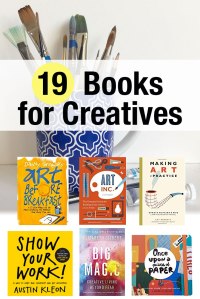
19 Books for Creatives

Be creative! It will super charge your senses

change
One of the side effects of living a creative life is your senses become super charged. Plainly stated you notice things. On a recent walk with a friend, I stopped her a few times to say, “Look at that!” Her response, “I forgot I was with an artist.” I was finding beauty in things she didn’t even notice. I mean just look at these flowers!
dahliaonwalk

I love this “stop and smell the roses” mentality. As a runner, I see things all the time that I’d never notice driving by in a car. I often stop running and snap a photo. A common caption on my Instagram is “Found during my run.” Many times these photos are inspiration for my paintings.

I’ve realized over the last year and half, how much the seasons inspire me. Here in New York, the leaves are just starting to turn. I see hints of it here and there. And I can’t wait. My recent artwork reflects how Fall is inspiring me.

This slideshow requires JavaScript.

I’m already doodling Halloween stuff in my sketchbook…can’t wait to share! 🙂