When I was younger and had less confidence in my artistic abilities I was hung up on talent. Nowadays I think of talent as just a starting point. It is almost irrelevant because if you work at drawing or painting, or whatever medium suits you, you will get better. I saw this in myself and in others (both online and in person). As I continue to paint my seascapes in acrylic paint (vs. my usual watercolor) I see how I have progressed. When I notice areas in a painting that need work, I try to improved them, or I think of ways to enhance these areas in the next painting.
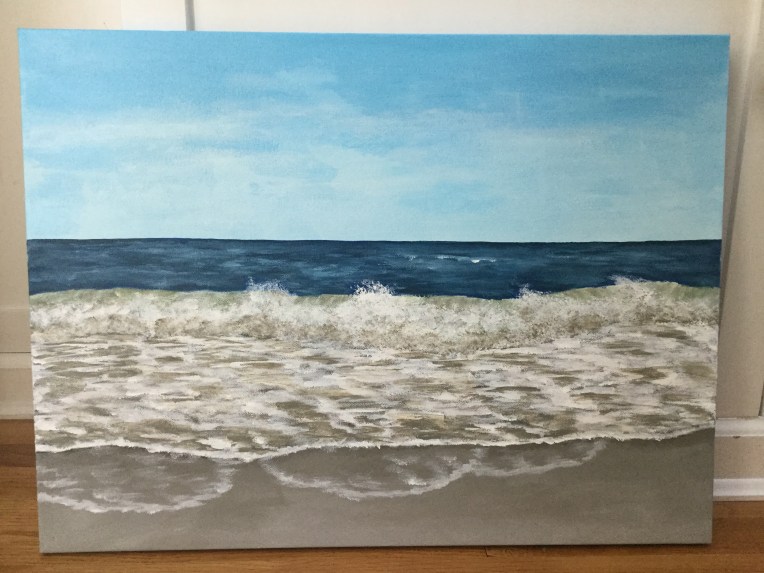
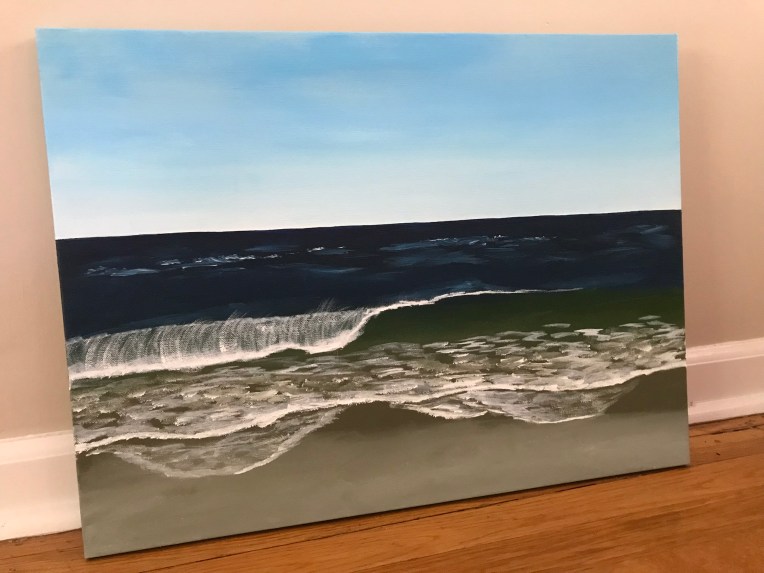
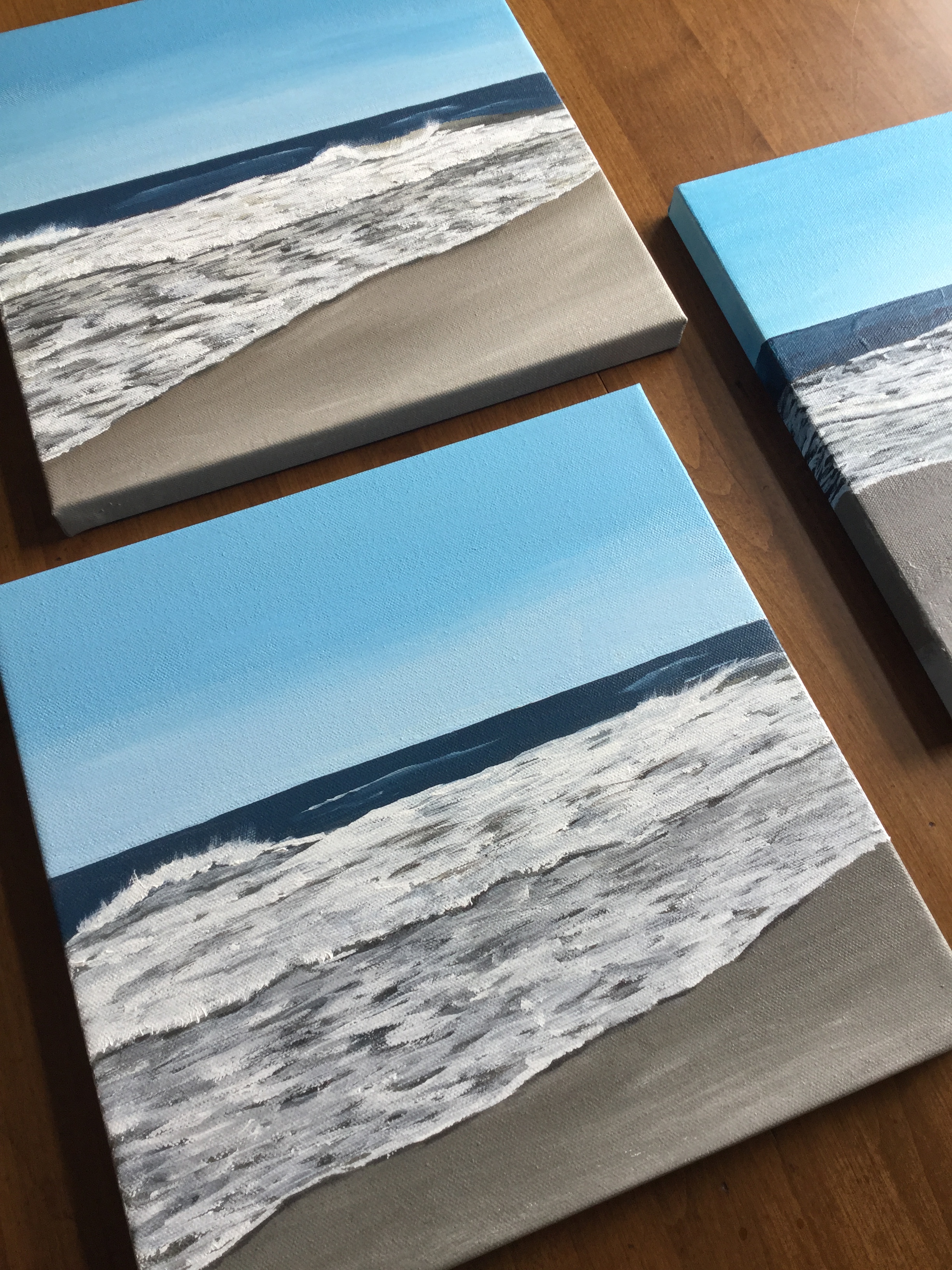
My first acrylic seascapes: Click here to view my collection of watercolor and acrylic seascapes.
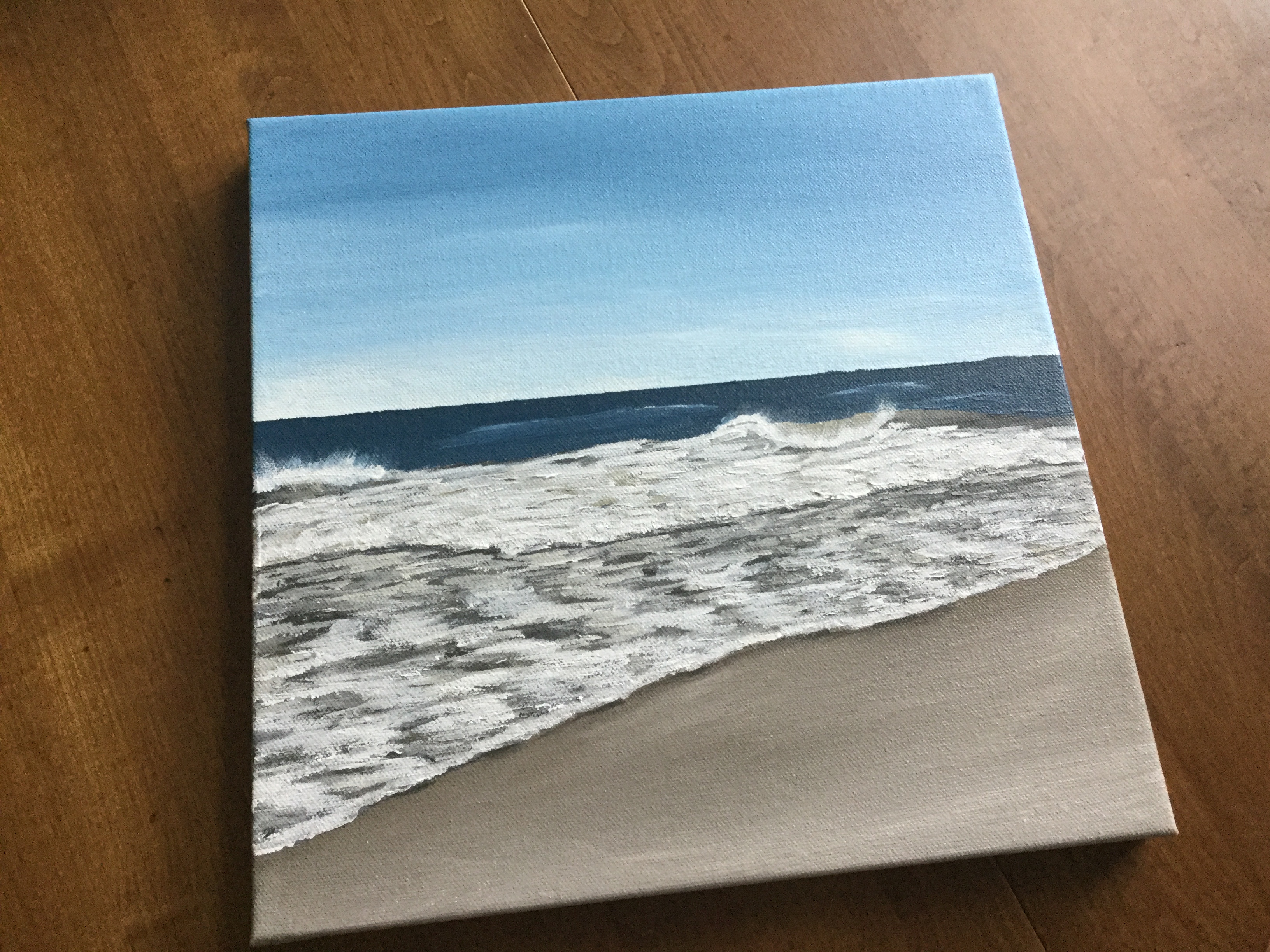
In May I switched from painting in watercolor to painting acrylic seascapes. I painted ten 12” x 12” canvases – intent on getting comfortable with the different medium. It was so frustrating in the beginning, but with each painting I learned something. I’ve pulled out the acrylics again – this time with bigger canvases, and I’m reminded of what I learned so far.
This post contains affiliate links to products/brands I use and recommend. I earn a small commission whenever you buy using these links, at no additional cost to you. Thank you for supporting my blog!
The beach has been the backdrop of my life. It’s where I was born and raised, played, worked as a lifeguard…and now enjoy summer days with my family. I spend a lot of time learning and practicing capturing the ocean in watercolor.
How to Paint the Ocean with Watercolor and Gouache:
1. Use a reference photo. It is very important to paint from a reference photo. All the details you want to capture to make your painting look realistic are in a photo.
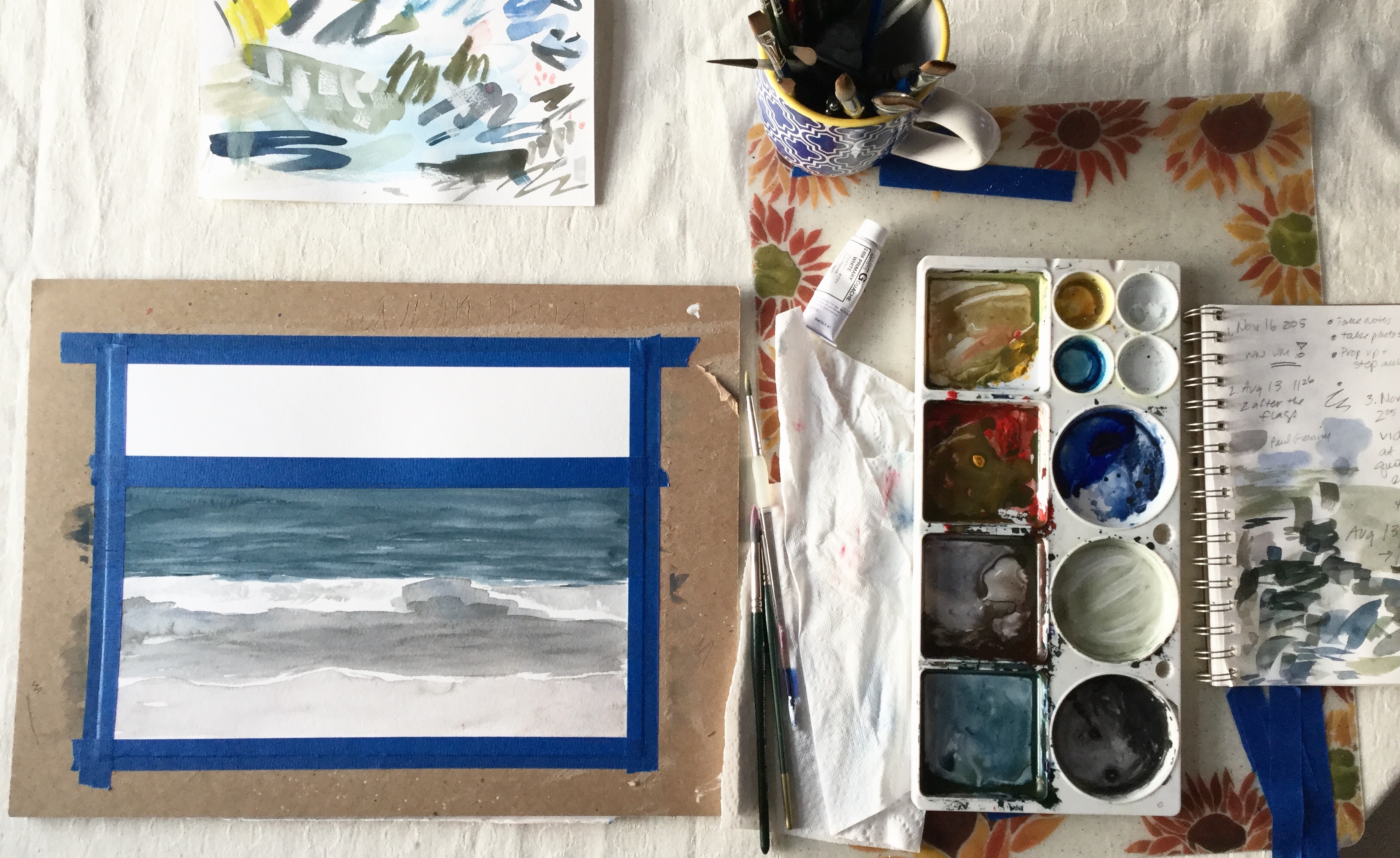
2. Tape your paper to a board. Tape your paper down to prevent it from buckling when it gets wet.
3. Tape your horizon line. To ensure a straight horizon line, use a ruler to measure and mark each side of the paper where the horizon line should be. Then tape across your paper above the pencil marks.
4. Mix your colors. I always mix my ocean colors to achieve more natural looking colors. In general from the horizon line to the sand the colors go from blue, to green, to brown.
5. Paint the first layer. Starting at the tape paint the distant ocean all the way to the dry sand, changing colors as you go. Don’t be afraid to overlap the colors.
6. Darken the first layer as needed. Add darks in the ocean for waves, etc. Refer to your reference photo. If the first layer is dark, consider lifting color with a damp brush to create highlights.
7. Paint the sky. Paint a simple fade where the color lightens as it gets closer to the horizon.
8. Paint the foam with white gouache. Gouache is more opaque than watercolor and you can paint over watercolor. I add white over the first layer of ocean colors to create the foam of the waves.
9+. Add details. Study your photo for little details – shadows in the breaking waves, etc. The details are what will make your painting more realistic looking.
Call it done! Every painting is a learning experience and information for the next painting. Call this one done and then try another one. The more you paint a subject, the better you’ll get at it.
I dive deeper into the process of painting seascapes in my video lesson and pdf tutorial. Give one a try!
Whoops! There was an error and we couldn't process your subscription. Please reload the page and try again.
This post contains affiliate links to products/brands I use and recommend. I earn a small commission whenever you buy using these links, at no additional cost to you. Thank you for supporting my blog!
I always have a few paintings in progress at once. With watercolor it’s about having to wait for the layers to dry. With acrylics it’s convenient to have a few going on, when you have the paint mixed up and ready.
Having more than one, takes the pressure off one particular painting. During my drawing class days, I became so stressed about a drawing I was working on. I was afraid to add a single mark and ruin it. Thankfully I realized the unnecessary pressure I put on myself to make every drawing frame-able, and I relaxed way back!
Click here to view my collection of watercolor seascapes. Prints are available on watercolor paper or canvas, in many sizes.
The other morning I sat down to paint in an effort to turn my bad mood around. As I was painting, and not feeling great about myself, I was thinking how much confidence plays a part in painting. When you are feeling good, you are hopeful about the outcome of a painting as you work. But when you are feeling low, it’s easy for negative thoughts to sabotage your work. At these times it’s even hard to motivate to sit down and paint in the first place.
Thankfully, painting did help turn my mindset around and most of the things bothering me either worked themselves out, or proved to not be as bad as I let them seem.
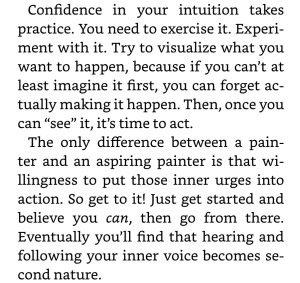
A few days later I was reading Chip Gaines’s book “Capital Gaines: Smart Things I Learned Doing Stupid Stuff.” Chip, along with his wife Joanna, starred in HGTV’s Fixer Upper. Chip’s book is about their story, and is also very motivational. Because of my recent thoughts on confidence and painting, this quote really spoke to me:
I’m glad that I sat down the other morning to paint despite my mood. I know that if you really want something, you have to work at it no matter what, and I’m trying to put that into practice. Check out Chip’s book here.
This post contains affiliate links to products/brands I use and recommend. I earn a small commission whenever you buy using these links, at no additional cost to you. Thank you for supporting my blog!
I often think about an online class I took by Val Webb called “Drawing Children.” At the time, I was amazed at how well Val knows the nuances of the faces and figures of children. Now as I paint the ocean – almost exclusively, mostly in watercolor, but recently in acrylics – I think about not just the techniques to make the painting look realistic, but the characteristics of the ocean.
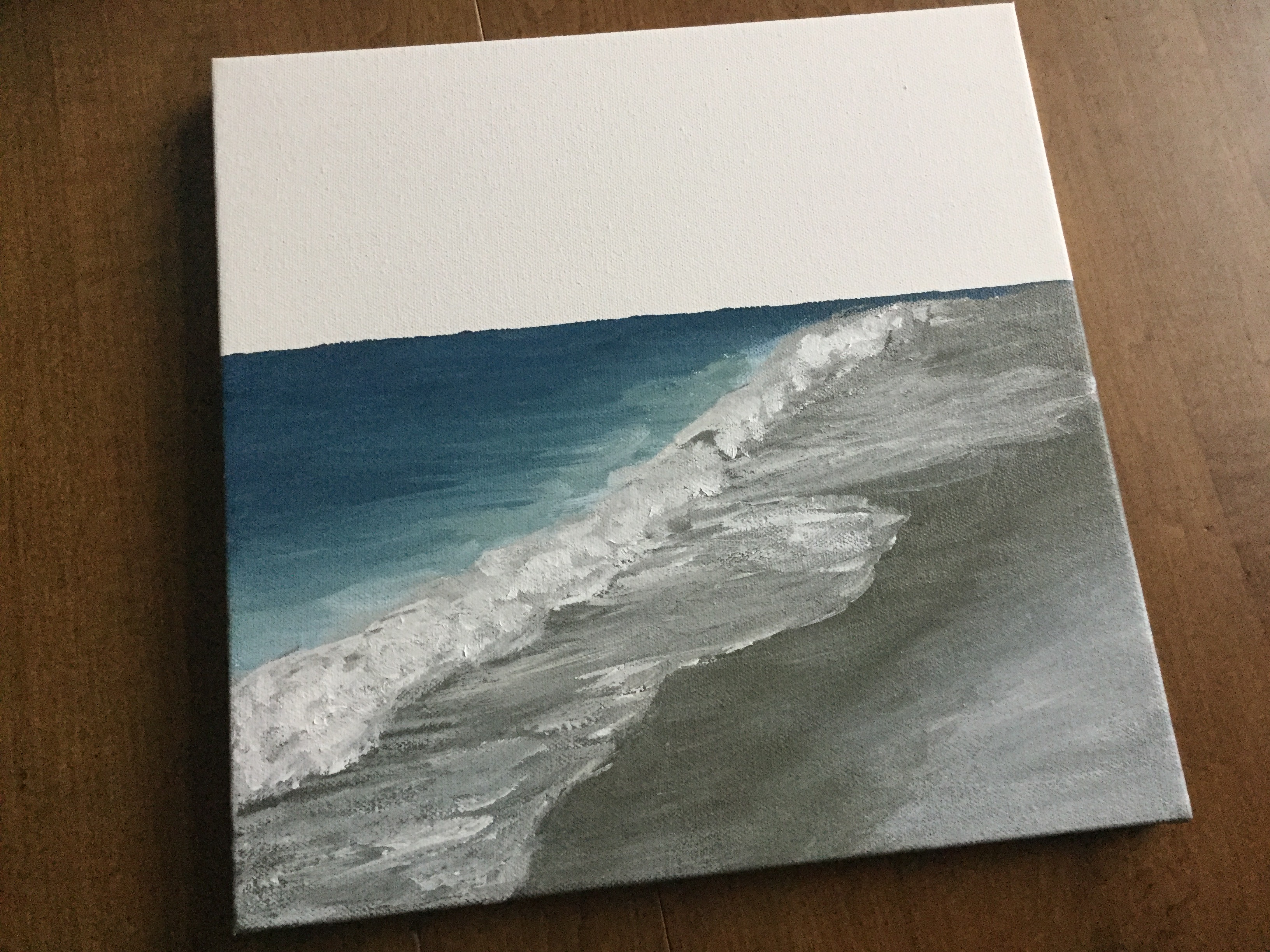
As I was painting the water, specifically the foam at high tide, I was painting and pulling back the strokes, because I was thinking about how the water is being pulled back by the tide. This is something you wouldn’t know just by looking at a photo. All the time I’ve spent at the beach might be making a difference in my painting. Last summer, after painting the ocean all winter, I looked and observed the water differently than before.
Work in progress where I was “pulling back”
My son recently asked if I was going to paint anything else. I guess to him, every painting is similar. To me I’m learning with each painting. The ocean looks so different at different times and different angles. I’m sticking with the ocean, and I’m currently challenging myself by working to capture this amazing subject in acrylics.
Click here to view my collection of watercolor seascapes. Prints are available on watercolor paper or canvas, in many sizes.
I’m so excited about my May project! After painting watercolor seascapes for over a year, I’m adding acrylic and canvas to my routine. I’ve purchased 10 canvases and plan on completing them by the end of the month.
I’ve painted in acrylics on and off over the years, but never enough to feel completely comfortable. Since starting my watercolor seascape project (almost a year and a half ago) I’ve wanted to try my techniques on canvas, and did try it once. The transition wasn’t as easy as I thought it would be. The colors I mixed weren’t quite right, and I felt uncomfortable painting at an easel – I’m used to working flat at a table with watercolor.
I decided to do a few things to make my Acrylic Seascape project easier:
A comfortable size. I purchased 12” x 12” canvases – a size I often work in with watercolor. This smaller size will be more manageable on a table, since I plan on working flat.
Shorter handled brushes. The acrylic brushes I have are probably designed for painting on an easel, but the longer handles feel awkward when painting at a table. I bought a new set of brushes with shorter handles.
Familiar colors. I bought new paints in the same colors I use for mixing my ocean and sand colors in watercolor.
A focused time period. My watercolor seascape project began as a month long project. Focusing on one thing, brought results quickly – I learned a lot and my technique improved. I’m hoping my plan of working on these 10 canvases over the month, yields similar results.
Following my seascape process. Over the past year and a half I’ve developed a process for painting seascapes. I plan on following my process, using my techniques, and learning along the way how to adapt it all to acrylic paint.
wish me luck!
Click here to view my collection of watercolor seascapes. Prints are available on watercolor paper or canvas, in many sizes.
I find it useful to have a small notebook opened next to my palette. This way if I have a thought for a blog post, want to remember which blue I’m using, or whatever, I can just scribble a note to myself. I also write down the date and time of the photo I’m painting from. This way it’s easier to find on my iPad when I sit down again to paint. This saves me a lot of time.
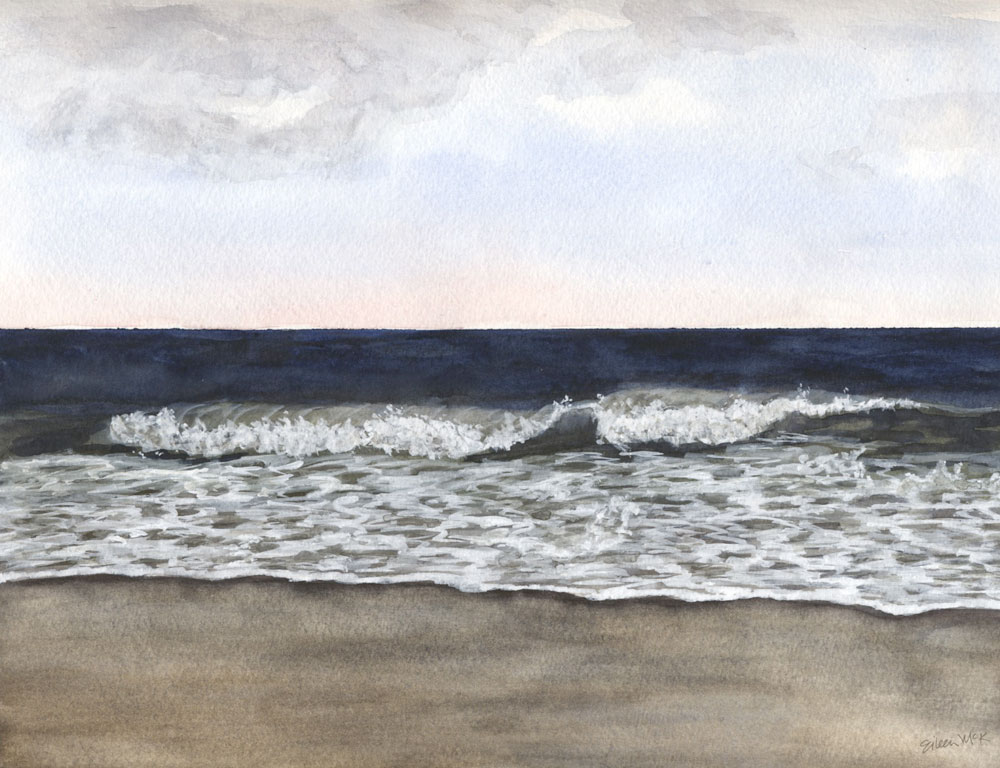
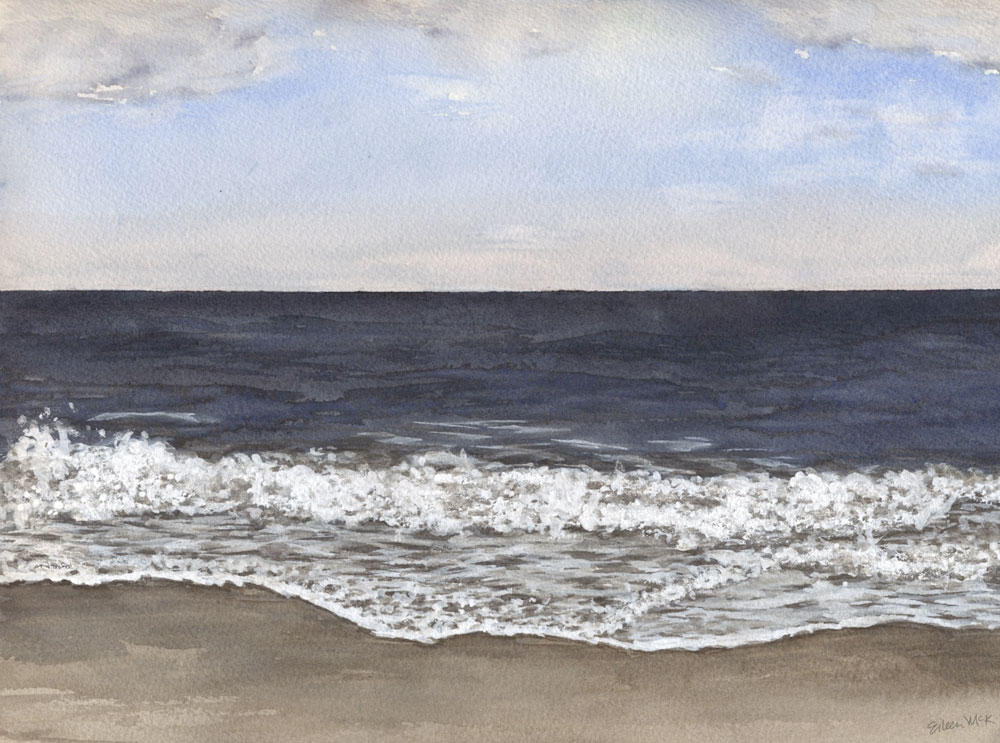
When I first started painting my seascapes, the skies were simple blue gradations, with the lightest blue closest to the horizon. With each seascape painting I started playing a bit more with the sky – trying to achieve the perfect sky blue, adding other colors as a glow on the horizon, adding a bit of texture for clouds.
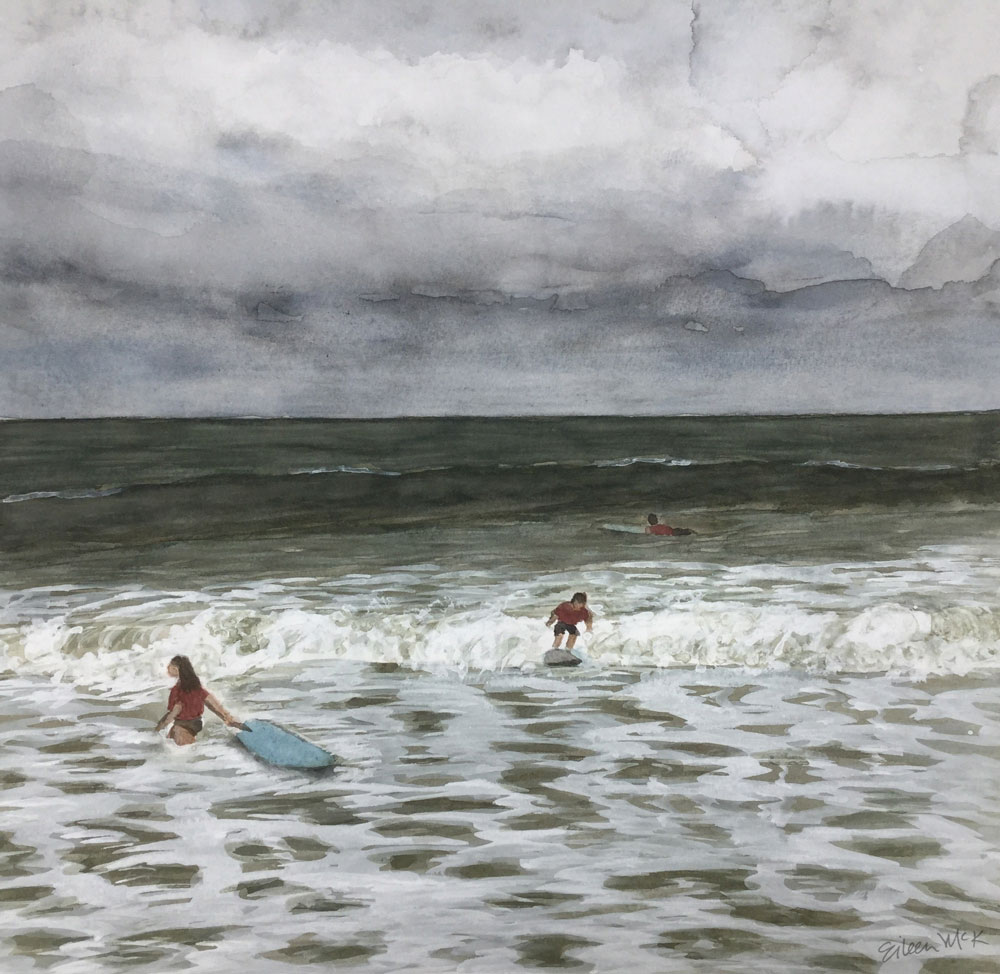
Then I did two painting with gray cloudy skies, which were a lot of fun.
Surf Camp 1
Surf Camp 2
Now more often than not, I’m adding colors and texture to my skies, like in these recent paintings.
November 1 by Eileen McKenna
November 2 by Eileen McKenna
I’m still striving to find the perfect mix of blue for “sky blue,” especially to capture those bright blue sky, summer days.
I even searched online for “best watercolor blue for the sky” and found a great post on Scratchmade Journal by Tonya, who experimented and discovered, “almost any combination of blues can be used to create a realistic sky in watercolor, but no single blue worked well alone.”
See all my seascape paintings and compare the skies at shop.eileenmckenna.com.Prints of my seascapes are available on watercolor paper or canvas, in many sizes including the new “mini” canvas 11″ x 14.”



 This post contains affiliate links to products/brands I use and recommend. I earn a small commission whenever you buy using these links, at no additional cost to you. Thank you for supporting my blog!











 mycreativeresolution.com